Improving building energy performance through technical insulation
Reading time: 3 minutes
Insulating pipes, ducts and technical components helps reduce energy losses and improve the efficiency of the building-services system.
Improving a building's energy rating does not mean focusing solely on wall insulation, windows or the roof. Energy performance depends on the building and its technical systems as a whole: the envelope, heat and cooling generators, distribution networks, domestic hot water, heating and cooling, ventilation and controls.
In this context, thermal insulation for building services can make a tangible contribution to reducing energy consumption. Pipes, air ducts, tanks, valves, manifolds and refrigerant lines carry energy: if they are not properly insulated, some heating or cooling energy is lost before reaching where it is needed.
The practical benefits are clear: lower distribution losses, more stable temperatures and improved system efficiency. Where technical-system losses are included in the applicable assessment method, the intervention may also support a better energy performance rating or certificate.
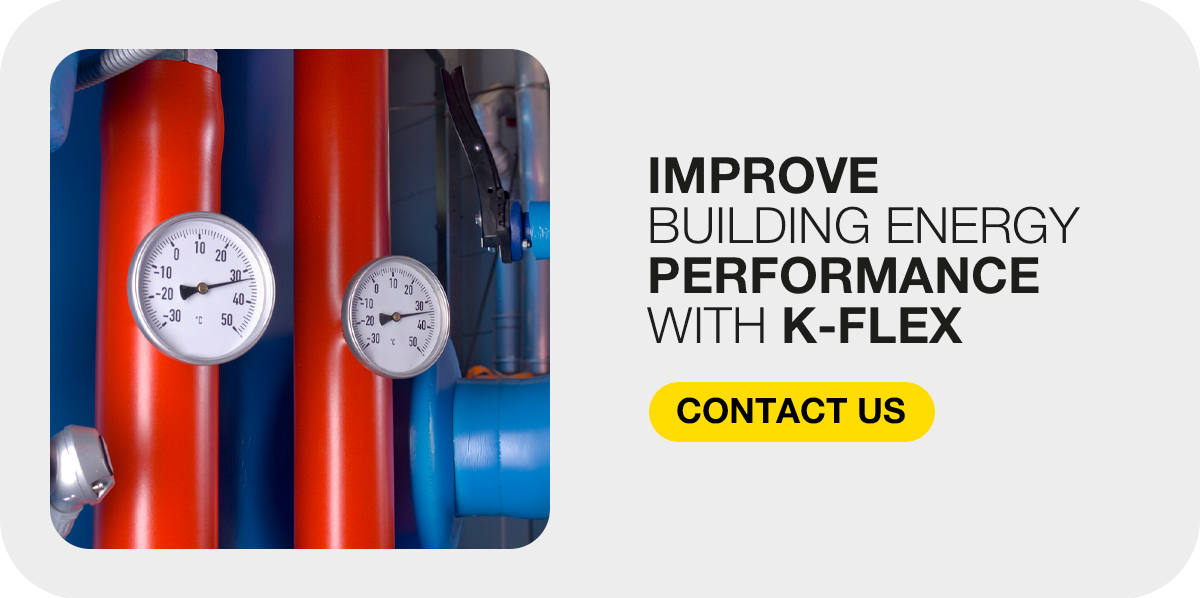
Why building services affect energy performance ratings
Across international markets, building energy performance is assessed through national or regional calculation methods and is often communicated through an Energy Performance Certificate (EPC) or an equivalent rating. Although terminology, metrics and thresholds vary by country, these assessments generally consider both the building envelope and the energy used by technical systems. Designers should therefore verify how distribution losses are treated under the method applicable to each project.
Technical insulation reduces distribution losses. An uninsulated or inadequately insulated network can lose energy in plant rooms, service shafts, garages, attics, technical rooms or unconditioned spaces. In these cases, the generator has to work harder to compensate for the energy lost along the distribution route.
This contribution is particularly significant in buildings with centralised systems, extensive networks, complex HVAC systems, heat pumps or solar thermal systems, as well as in energy retrofit projects.
Where energy losses occur
The most common energy losses involve heating and domestic hot-water pipes. If heat is released into spaces where it is not useful, that portion of energy does not contribute to indoor comfort and reduces overall efficiency.
In chilled-water networks and refrigerant lines, the issue also concerns condensation. When the pipe surface temperature falls below the dew point, moisture in the air can condense, causing dripping, material degradation and a risk of corrosion under insulation.
Air ducts are also critical: uninsulated ductwork can alter the temperature of the conveyed air, increase the load on air-handling systems and compromise comfort and system balancing.
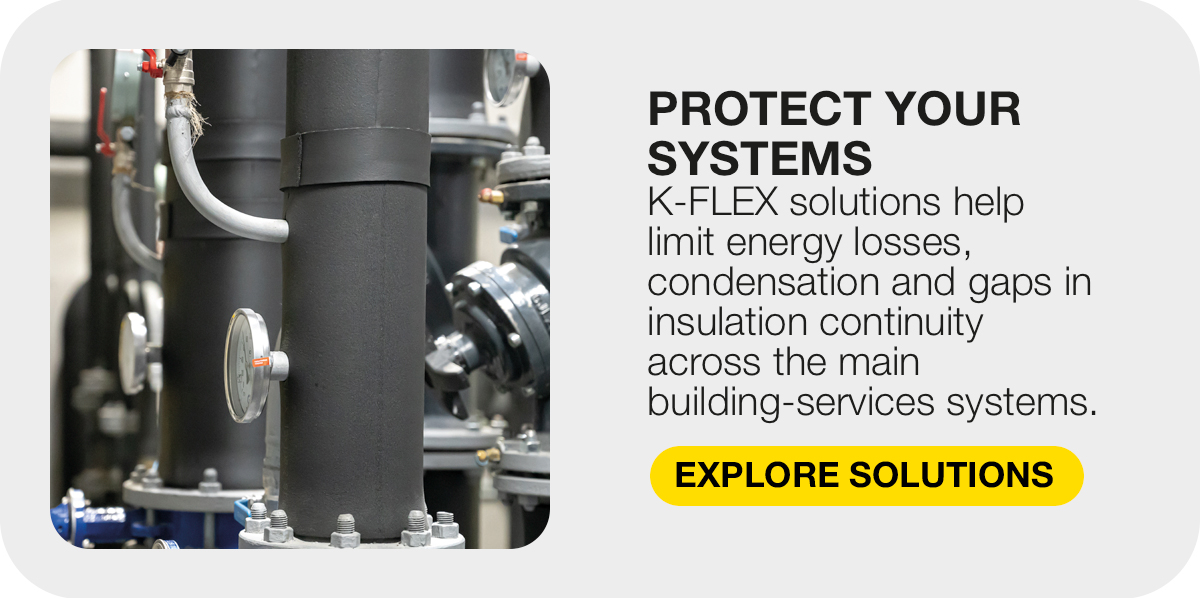
Certifications, energy standards and K-FLEX products supporting the project
Improving energy performance and meeting certification or sustainability requirements do not depend on a single material, but on a coordinated set of documented design choices. Technical insulation can nevertheless contribute by reducing energy losses from building services, protecting networks against condensation and degradation, improving performance continuity and providing useful data for project verification across different regulatory contexts.
Under national EPC methodologies, insulating pipes, ducts and technical components can help reduce distribution losses and therefore support improvements in the building's overall energy performance. In this context, solutions such as K-FLEX ST for hot- and cold-water pipes, K-FLEX ST DUCT for air ducts and K-FLEX K-BOX for valves and special components can help maintain insulation continuity throughout the network.
In high-performance buildings designed to nearly zero-energy or zero-energy standards, where energy demand must be kept very low, even residual losses from technical systems become significant. Products such as K-FLEX ST, K-FLEX ST DUCT, K-FLEX SOLAR HT and solutions for heat pumps and solar thermal systems help limit losses in distribution networks, improving consistency between designed performance and actual operation.
From this perspective, K-FLEX ECO, formulated without halogens, PVC, CFCs or HCFCs and available with an EPD according to catalogue data, is particularly relevant in projects where energy performance and environmental criteria must be assessed together. K-FLEX AL CLAD SYSTEM, meanwhile, can be useful where insulation must maintain mechanical protection, weather resistance and durability over time in exposed applications.
Selection must always begin with the local application context: fluid temperature, climate, installation environment, condensation risk, fire-safety requirements, weather exposure and the documentation required by the relevant national standard, rating system or energy assessment method. In this way, K-FLEX solutions are considered not simply as insulation materials, but as technical components that support efficiency, reliability and project verifiability.
FAQ
Can technical insulation improve a building's energy performance rating?
Yes. It can help improve energy performance when it significantly reduces the distribution losses included in the building's overall energy calculation.
Does technical insulation replace improvements to the building envelope?
No. It is a complementary measure that works alongside envelope insulation, generator efficiency, controls and system optimisation.
Which standards and rating systems can technical insulation support?
Depending on the project and market, technical insulation can support national EPC methodologies, nearly zero-energy or zero-energy targets, and international schemes such as LEED and BREEAM. Its contribution must be assessed against the applicable calculation rules and supported by the required technical documentation.
Why are product technical data and certifications needed?
They help select the correct material, document performance, meet local regulatory requirements and make the project's energy assessment more reliable and transferable across international design teams.