Multilayer pipes and high temperatures:
why thermal resistance matters in building systems
Reading time: 3 minutes

Choosing the right pipe helps protect system continuity, comfort and long-term reliability in plumbing, heating and cooling applications.
In domestic water, heating and cooling systems, resistance to high operating temperatures is not only about withstanding a temporary thermal peak. The key issue is long-term durability: the ability of the pipe to maintain stable performance when temperature, pressure and repeated operating cycles act together.
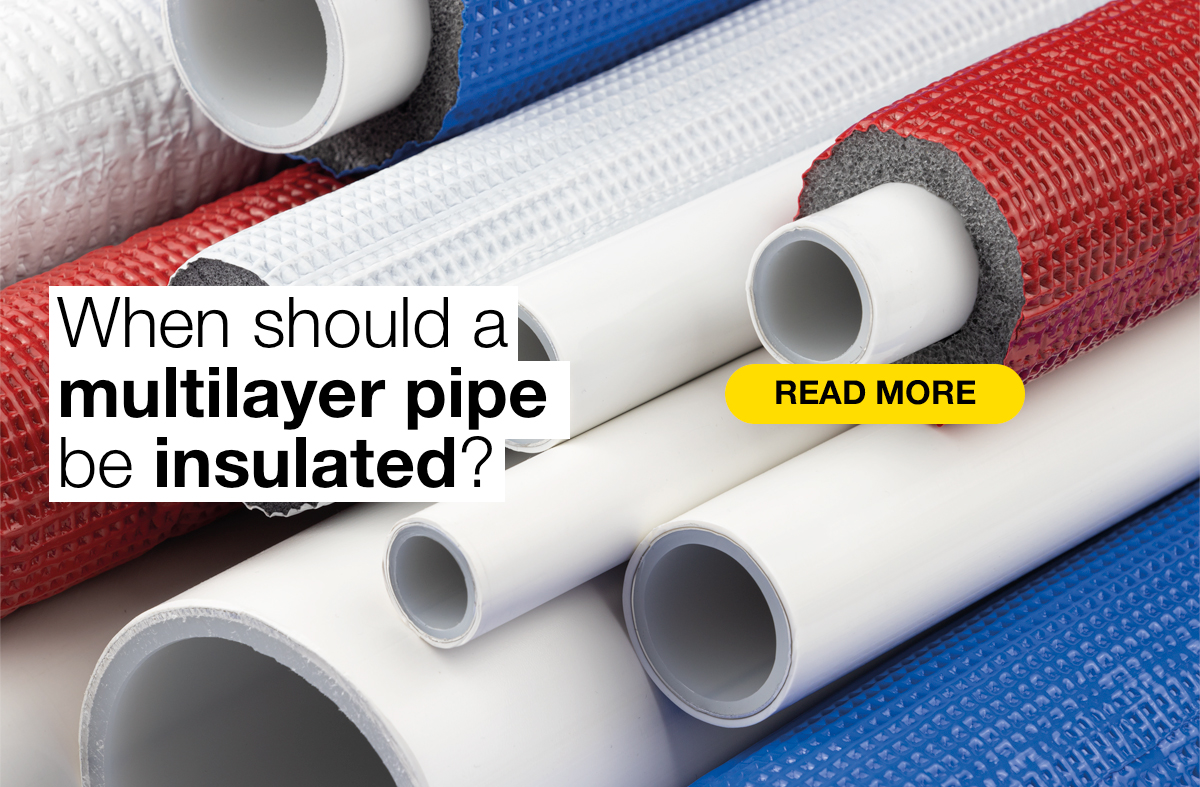
Multilayer pipes answer this need by combining different materials, each with a specific technical function. This layered structure helps improve dimensional stability, mechanical resistance, oxygen barrier performance and operating reliability compared with many single-material solutions.
For designers, installers and technical operators in any market, pipe selection should start from one essential principle: maximum temperature, pressure and application class must be assessed together, not as separate values.
What high-temperature resistance really means
In a real installation, a pipe never works under isolated conditions. Temperature interacts with internal pressure, exposure time, thermal cycles, water quality, bending radius, fixing method, fittings and manifolds.
This is why a value such as 90 °C or 95 °C must always be read in its technical context. A maximum temperature indicates a declared limit condition, but project evaluation must also consider the expected operating profile. An underfloor heating system normally works at lower temperatures than a traditional radiator system, but the pipe must still be designed to withstand transients, tests, peaks and safety margins.
High-temperature resistance is therefore a system performance. The pipe must not simply “hold” at start-up; it must continue to perform correctly after years of thermal and pressure cycles.
How the multilayer structure works
In multilayer pipes, each material contributes to a specific function. K-FLEX SOLID uses a 5-layer structure: PE-RT II, adhesive, aluminium, adhesive, PE-RT II. PE-RT II, a second-generation polyethylene of raised temperature resistance, contributes to flexibility and thermal performance; the aluminium layer improves mechanical stability, shape retention, reduced thermal expansion and oxygen-tightness.
The oxygen barrier is particularly important in closed circuits. Oxygen diffusion can encourage corrosion, metal oxides, sludge formation and reduced heat exchange. An effective barrier helps protect not only the pipe, but also manifolds, valves, pumps, heat exchangers and generators.
For radiant systems, K-FLEX EVOH uses a PE-RT II / EVOH / PE-RT II multilayer structure, where the EVOH layer acts as the oxygen barrier. The choice between aluminium and EVOH depends on the application, operating conditions, installation requirements and the system in which the pipe is used.
Temperature, pressure and application classes
EN ISO 21003 is an important reference for multilayer piping systems used in hot and cold water installations inside buildings because it connects temperature, pressure and application classes.
K-FLEX EVOH indicates application classes according to EN ISO 21003-2:2009+A1:2011, including Class 4 and Class 5 configurations depending on diameter, pressure and temperature.
This distinction has a practical impact. Low-temperature radiant systems, low-temperature radiators, traditional radiators and hybrid systems can work with very different operating profiles. Reading temperature and pressure together helps select the pipe according to the real function of the installation.
Certifications and compliance as technical checks
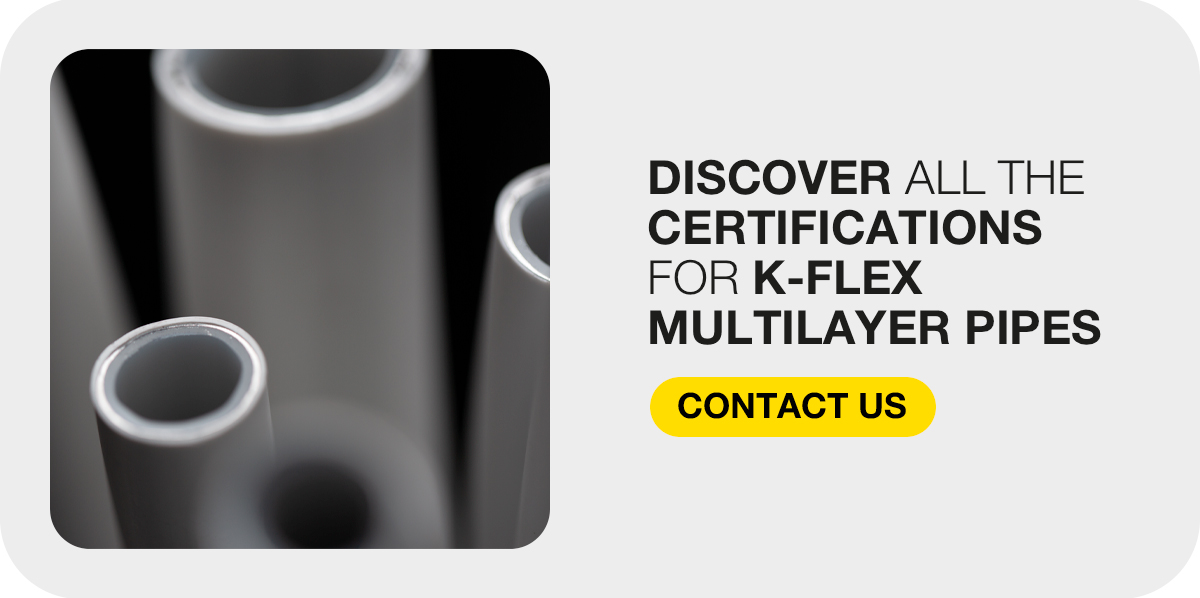
Certifications and technical compliance help verify that a pipe has been designed, manufactured and tested according to recognized requirements. They are not just paperwork: they allow designers, installers and clients to check whether the product is consistent with the intended application, operating conditions and project specifications.
For multilayer pipes, the most relevant checks may concern resistance to temperature and pressure, long-term durability, dimensional characteristics, material behavior, suitability for domestic water contact where required, pipe-fitting system performance and production control.
It is important to distinguish between technical standards, product certification and application suitability. A standard defines requirements and test methods; certification confirms compliance with a specific scheme; application suitability depends on the project, transported fluid, real operating conditions and local requirements.
For this reason, it is not enough to check whether a generic certification is present. It is necessary to verify which product it refers to, which diameters it covers, which fitting system it includes, which temperature and pressure limits apply and which application is covered.
Factors to consider when choosing a pipe
- Application class
It helps determine whether the pipe is intended for radiant systems, low-temperature heating or higher-temperature radiator circuits. The practical impact is better alignment between pipe and operating profile. - Temperature and pressure ratio
Maximum temperature and admitted pressure must be read together. This reduces the risk of choosing a pipe that is suitable for a thermal peak but not for the actual operating cycle. - Oxygen barrier
In closed circuits, it limits oxygen diffusion into the technical fluid. This helps protect metallic components and preserve system efficiency over time. - Dimensional stability
Controlled thermal expansion reduces stress on fixing points, bends, fittings and penetrations. This supports easier installation and more predictable operation. - System compatibility
Pipes, fittings, manifolds and accessories must be evaluated as part of one system. The declared performance of the pipe does not replace coherent system design.
The role of K-FLEX
K-FLEX multilayer pipe solutions support different but complementary requirements: thermal resistance, oxygen barrier performance, installation stability and integration with system components. K-FLEX SOLID is designed for applications requiring a PE-RT II / Al / PE-RT II multilayer pipe with strong dimensional stability, while K-FLEX EVOH is designed for radiant systems where flexibility, bending radius, pressure resistance and circuit protection are key factors.
Where insulation is required, K-FLEX SOLID preinsulated combines the multilayer pipe with polyethylene insulation for heating, cold and hot water supply, ventilation, air conditioning and underfloor applications.
The correct choice always depends on project conditions, flow temperature, pressure, application class, local requirements and available technical documentation.
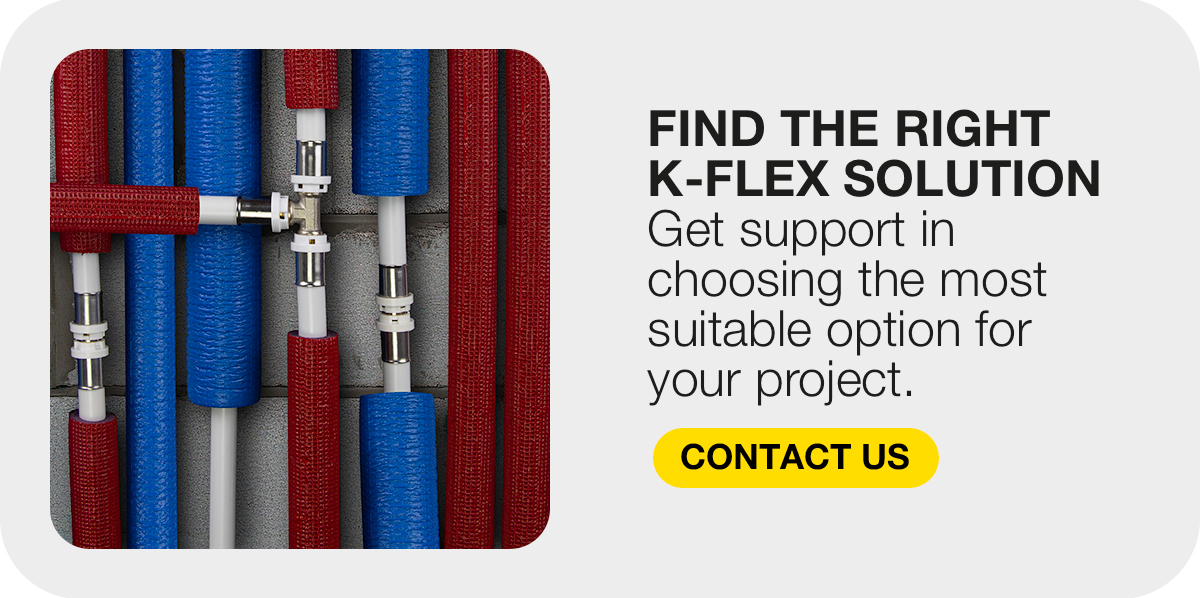
Find the right K-FLEX solution. Get support in choosing the most suitable option for your project.
FAQ
What makes a multilayer pipe suitable for high temperatures?
The combination of material selection, multilayer structure, pressure resistance, oxygen barrier and application class compliance.
Why should temperature and pressure be assessed together?
Because a pipe can withstand a given temperature only under pressure and operating conditions consistent with its declared performance profile.
What is the purpose of the oxygen barrier?
It limits oxygen diffusion into closed circuits, helping reduce corrosion risk and preserve the efficiency of metallic components.
Does certification always guarantee pipe suitability?
No. Certification must be checked against the specific product, diameter, fitting system, application, standard reference and operating conditions.
You might also be interested in