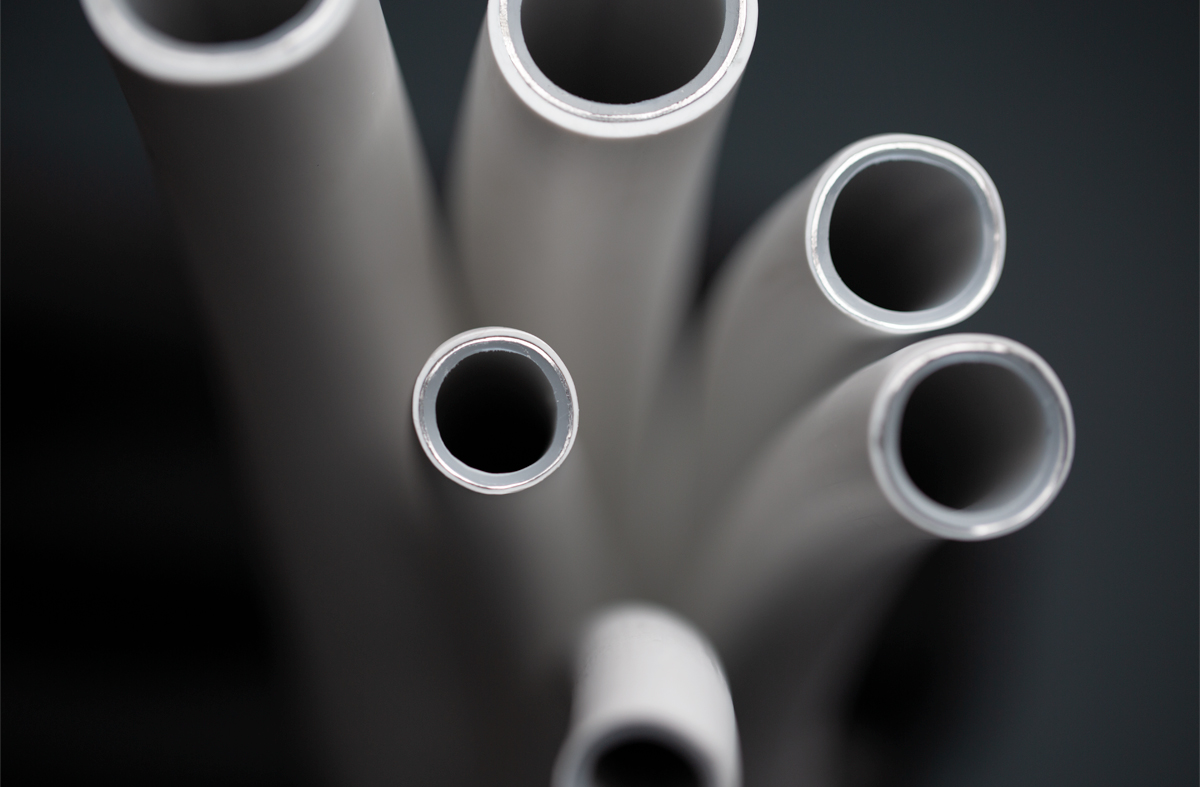
The composition of multilayer pipes
Modern plumbing and heating networks are expected to deliver stable performance over time, even under variable operating conditions. In these systems, the pipe wall is more than a simple conduit: it is a functional component that must withstand pressure cycles, temperature variations, and long service life requirements while maintaining reliability and installation efficiency.
That is why multilayer pipes have become a reference solution in hydrothermal sanitary and heating applications. Their value comes from a precise material composition, engineered to combine the key advantages of different materials in a single structure.
Multilayer pipes are designed as “multiple layers working as one”. The goal is to combine flexibility and corrosion resistance with shape retention and durability, supporting both everyday installation needs and long-term system reliability.
A common and widely adopted construction is the five-layer PE‑RT II / adhesive / aluminium / adhesive / PE‑RT II structure. Each layer has a defined role and contributes to the overall performance of the pipe.
The PE‑RT II layers form the inner and outer surfaces of the pipe. They support flexibility and protect the structure against corrosive environments, helping the pipe maintain durable performance in building and industrial contexts.
Between polymer and metal, the adhesive layers act as coupling interfaces. Their function is to create a stable bond between materials with different mechanical behaviour, enabling the multilayer wall to behave as a single composite system over time.
At the core, the aluminium layer provides dimensional stability and supports shape retention during installation and operation. In K‑FLEX multilayer designs, the aluminium core is longitudinally butt‑welded to achieve homogeneous wall thickness and to create an oxygen‑tight barrier, which is a critical element for system integrity in many applications.
This composition contributes to predictable behaviour under real operating conditions. It supports resistance to pressure and temperature variations, limits heat expansion, and helps maintain installation geometry—factors that can reduce stress on joints and support long-term reliability.
K‑FLEX multilayer pipes are designed for hydrothermal sanitary systems across civil, industrial, and tertiary sectors, including drinking‑water applications. Technical specifications reference dimensional requirements and performance testing conditions, and installation guidance such as minimum bending radius is provided to support correct on‑site handling.
Beyond the material structure itself, K‑FLEX supports professionals with clear documentation and technical resources to help select the right configuration for each project and to apply best practices during installation and commissioning.
DISCOVER MORE TECHNICAL INSIGHTS AND EXPLORE K‑FLEX MULTILAYER PIPES