Data center cooling system insulation: faster installation for chilled water piping and ductwork
Reading time: 3 minutes

Practical insulation solutions for schedule-driven data center projects
Data center projects need insulation systems that support reliable cooling, efficient installation and predictable jobsite execution. For chilled water piping and HVAC ductwork, the right elastomeric insulation can help contractors reduce material waste, speed up installation and maintain consistent application quality across demanding, fast-moving projects.
K-FLEX provides data center insulation solutions for chilled water piping and ductwork, including self-seal tubing, field-fabricated sheet insulation and pre-cut liner formats designed to simplify installation and reduce waste.
Why insulation matters in data center cooling systems
Cooling infrastructure is central to data center reliability. Chilled water piping and duct systems must help maintain stable thermal performance while limiting unnecessary energy loss and installation variability.
In these environments, insulation is not only a thermal requirement. It is also a project execution issue. Large pipe diameters, repeated duct sections and tight construction schedules can make field cutting, fitting and sealing time-consuming. Every extra cut can increase labor time, material waste and the risk of inconsistent seams.
That is why factory-applied adhesive systems, self-seal formats and pre-cut components can make a measurable difference for contractors working on competitive data center jobs.
Self-seal insulation for chilled water piping
For chilled water piping up to 8” IPS, K-FLEX INSUL-LOCK DS is designed as a pre-slit, closed-cell flexible elastomeric insulation with a factory-applied adhesive system. This helps simplify installation on small- and medium-bore piping and supports more consistent seam closure.
For piping 10” IPS and above, K-FLEX offers K-FLEX INSUL-SHEET rolls for field fabrication, as well as K-FLEX INSUL-LOCK DS LP self-seal pre-cut sheets.
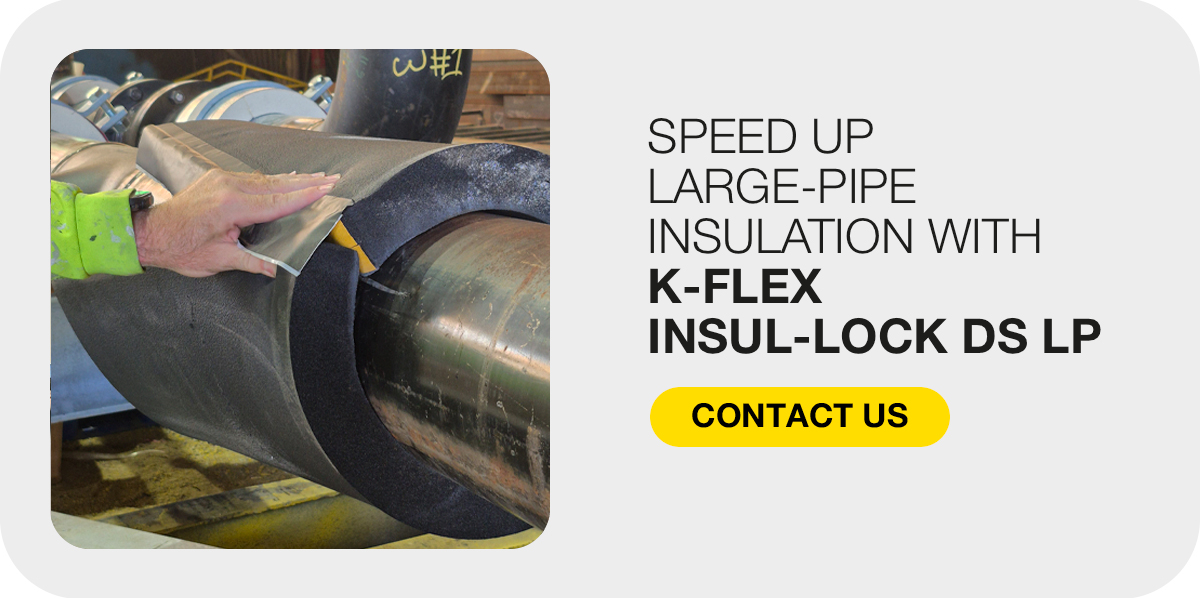
K-FLEX INSUL-LOCK DS LP is designed to simplify insulation work on large-diameter chilled water piping, where cutting insulation from standard rolls can be time-consuming and generate unnecessary waste. The system uses 4-foot-wide sheets cut to the required pipe circumference, with an overlap strip and PSA adhesive applied along one edge. Once installed, this creates a clean overlap appearance while reducing field fabrication, helping contractors improve consistency, shorten installation time and control material use on large-scale data center cooling projects.
The practical benefit is straightforward: less cutting from rolls, less jobsite waste and faster installation compared with traditional field-cutting methods.
Duct insulation for sheet metal shops
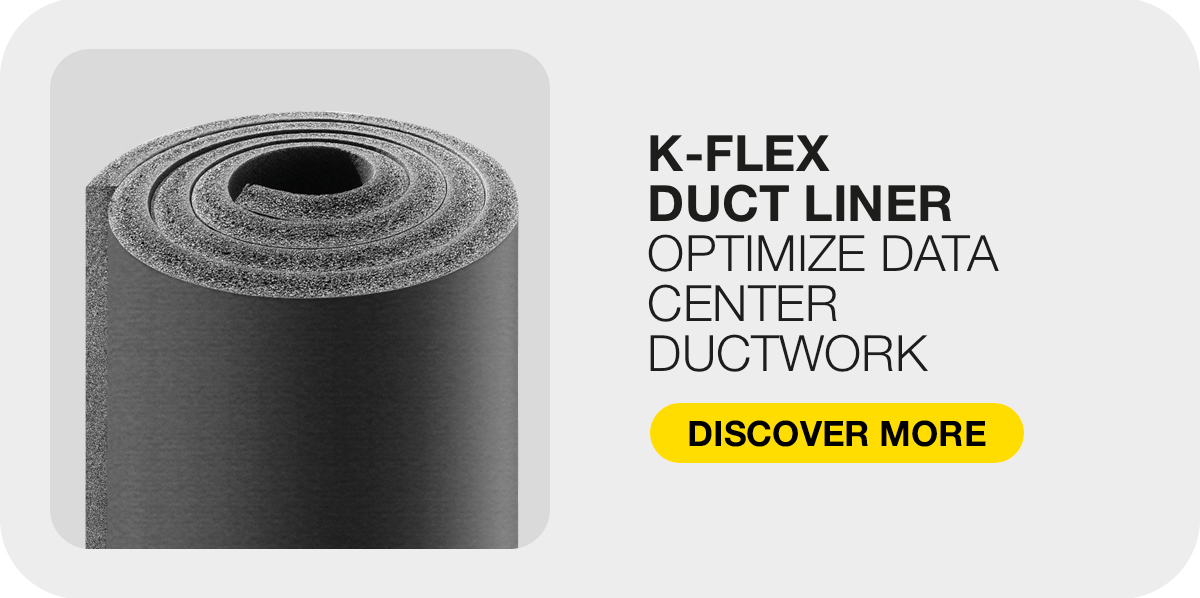
Data center ductwork also benefits from insulation formats that reduce repetitive manual work. K-FLEX DUCT LINER is a closed-cell flexible elastomeric foam insulation for thermal and acoustic duct applications.
For ductwork, K-FLEX offers standard DUCT LINER rolls and pre-cut duct liner sheets sized for commonly used sheet metal dimensions. These pre-cut sheets are intended to help sheet metal shops reduce on-site cutting, lower labor requirements and deliver faster, more consistent duct fabrication.
By matching liner sheets to common metal sizes, contractors can reduce offcuts and simplify the insulation process before duct sections reach final installation.
Certifications and technical documentation to verify
In data center projects, technical documentation matters because insulation can affect indoor air quality, mold resistance requirements and overall system reliability.
K-FLEX INSUL-LOCK DS is listed as UL GREENGUARD Gold Certified for low VOC emissions, with key physical properties approved by Factory Mutual. K-FLEX INSUL-SHEET is also listed as UL GREENGUARD Gold Certified for low VOC emissions. K-FLEX DUCT LINER is listed as UL Validated for mold resistance and UL GREENGUARD Gold Certified for low VOC emissions.
These certifications should always be checked against the current technical data sheet for the specific product and project requirement.
Key factors to consider
- Pipe diameter
Smaller chilled water lines may benefit from self-seal tubing, while larger lines may require sheet or pre-cut solutions. The impact is faster fitting and less field fabrication. - Required thickness
The attached document identifies insulation options available up to 2”. Thickness should be evaluated against operating temperature, ambient conditions and condensation-control needs. - Jobsite labor and waste
Pre-cut sheets and factory-applied adhesive systems can reduce cutting time and material waste, which is especially valuable on schedule-driven data center projects. - Product-specific certifications
Low VOC, mold resistance and performance approvals should be tied to the exact product being specified, not assumed across an entire range.
Conclusion
For data center contractors, insulation selection affects more than thermal performance. It can influence jobsite productivity, installation consistency, waste reduction and project margins.
K-FLEX supports these needs with elastomeric insulation solutions for chilled water piping and ductwork, including self-seal tubing, field-fabricated sheet insulation and pre-cut duct liner formats designed for demanding data center applications.

FAQ
What insulation is used for chilled water piping in data centers?
Closed-cell elastomeric insulation is commonly used to help control heat gain and condensation risk on chilled water piping. K-FLEX offers self-seal tubing for smaller pipe sizes and sheet or pre-cut solutions for larger diameters.
Why are pre-cut insulation sheets useful?
Pre-cut sheets reduce field cutting, help limit material waste and can shorten installation time, especially on projects with repeated pipe or duct dimensions.
Is K-FLEX DUCT LINER used for HVAC ductwork?
Yes. K-FLEX DUCT LINER is designed for duct insulation applications and provides thermal and acoustic insulation in a closed-cell elastomeric foam format.
What certifications should be checked?
Project teams should verify product-specific documentation, including UL GREENGUARD Gold for low VOC emissions, UL validation for mold resistance where applicable, and any performance approvals required by the specification.